 Almanac Read
Part of This Spoonful Is the Oat the Mushroom Grew On
Half a teaspoon of powder, three ingredients, and one number covering all three. I weighed the scoop, read the panel and counted the mornings in the bag.

This is a paid advertisement. Sponsored by Laird Superfood, Inc.

Alvin Boone is the byline this desk writes under.
Everything on this page about the bag comes from the maker's own product page, the photograph of its official panel, and its published terms, all read on September 20, 2026.
There is a shelf in my kitchen where the coffee lives, and for about ten years nothing on it has changed.
Same grinder, same kettle, same white mug with a chip in the handle.
So when a neighbor handed me a blue pouch last month and asked whether he should be stirring it into his, the question landed somewhere particular.
It was not really a question about mushrooms.
It was a question about whether half a teaspoon of anything can matter.
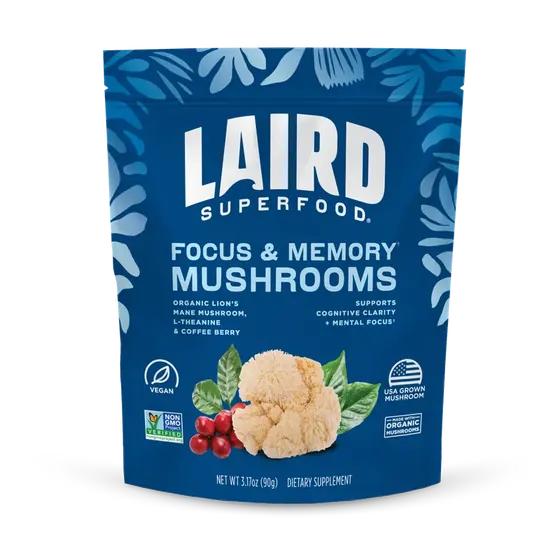
The pouch was Focus and Memory Mushrooms, made by Laird Superfood, a company in Sisters, Oregon.
Three ingredients on the front: organic lion's mane, L-theanine and coffee berry.
The method I use on anything that reaches this desk is the same one you would use on a bag of seed or a can of paint.
Find the unit the maker sells in, find the weight of that unit, and then find out what the research put in front of people, by weight, for how long.
If those two weights are close, the bag has a case. If they are not, you deserve to know by how much before you pay.
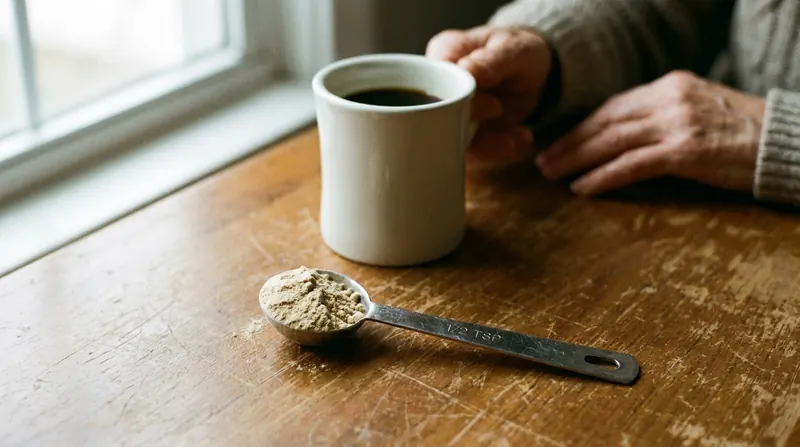
On this bag the unit is a scoop, and the scoop is half a teaspoon.
Half a teaspoon of this blend weighs 1.3 grams, which is a number the maker prints and which almost nobody stops to picture.
Picture it anyway.
A level half-teaspoon of powder is about what you would tap onto the back of your thumbnail, and it is the whole daily amount of everything this bag is sold for.
Now the part that took me a second morning to work through.
Those 1.3 grams are printed as a single line called the Focus and Memory Blend, and that one line covers all three ingredients at once.
The panel does not say how much of the scoop is lion's mane, how much is L-theanine and how much is coffee berry.
Nobody outside the company knows, and I want that understood before anything else on this page.
There is a second thing inside that weight, and it is the one I had not expected.
The lion's mane in this bag is described as mycelium and fruiting bodies grown on gluten-free organic oats, which means some part of the mushroom's share of the scoop is the grain it was grown on.
Part of the spoonful is oat, and the bag does not say how much.
That is not an accusation.
It is how a great many mushroom powders in this country are made, it is printed openly on this bag, and most buyers have never been told what the sentence means.
What follows is the whole reading, in the order I did it: the scoop, the blend line, the oats, then each of the three ingredients beside the study that tested it, and then the calendar, which turned out to be the most interesting part of all.
Half a Teaspoon, and What Half a Teaspoon Weighs
Start with the arithmetic, because the arithmetic is the whole argument and it takes four minutes.
The pouch holds 3.17 ounces, which is 90 grams.
A serving is half a teaspoon of the blend, which the maker states as 1.3 grams.
Divide ninety by one point three and you get sixty-nine.
Sixty-nine servings in the bag, which at one scoop a morning is sixty-nine mornings, and that number will matter twice more before this page is finished.
Five calories and one gram of carbohydrate per serving, which is nothing in a day and worth saying plainly for the men who count both.
There is no sugar line and no sweetener on the panel, which is unusual on a shelf where most powders arrive pre-sweetened.

Now hold 1.3 grams in your head as an object rather than a number.
A United States nickel weighs five grams; this scoop is about a quarter of that coin.
A teaspoon of ordinary table salt weighs around six grams, so a level half teaspoon of salt is about three grams, more than twice the weight of this scoop, because salt is dense and this powder is light and airy.
That is why the maker prints the weight as well as the spoon size, and printing both is to their credit.
It also means the scoop is the smallest daily amount of anything I have weighed at this desk in a month.
Everything else on this page is the question of whether 1.3 grams, split three ways, can carry its own weight.
One more number from the panel before we leave it.
The maker says the powder has no fillers in it, which is a real claim about a powder and one you can partly check yourself: a bag cut with maltodextrin or rice flour dissolves clean and tastes of nothing, and this one is described as leaving sediment.
Ninety grams in the bag, 1.3 grams in the scoop, sixty-nine scoops to a bag. Those three numbers do more work on this page than any sentence on the front of the pouch.
Three Names and One Number
Turn the pouch over, because the back is a different document from the front.
The panel prints one line for the actives: Focus and Memory Blend, 1.3 grams.
Under that line, in smaller type, come the three things inside it, in order: organic lion's mane mushroom, L-theanine, and coffee berry.
There is no number beside any of the three.
That arrangement has a plain name in this trade: it is a blend line, and it is entirely legal.
A maker is required to list every active ingredient and to give the total weight of the blend.
A maker is not required to say how that total is divided, and a great many do not.
One number, three ingredients, no split printed anywhere.
I have read enough panels to know why a company would print it that way, and there are two reasons, only one of which is unflattering.
The flattering reason is that a formula is work, and printing the exact split hands your competitors the recipe for the price of one bag.
The unflattering reason is that a blend line lets a bag carry a famous ingredient at an amount too small to mean anything, tucked inside the weight of the cheap one.
I am not saying this bag does that, because I cannot see inside the line any more than you can, and that is exactly the point.
Here is what the missing split costs you as a reader, in one sentence.
Every study I am about to put beside this bag was run at a known amount of one ingredient, and this bag will not tell you what amount of that ingredient you are holding.
So every comparison on this page has a ceiling and no floor.
The ceiling is the whole 1.3 grams, which you reach only if the entire scoop were that one ingredient, and the floor is a pinch.
That sounds like an argument for walking away, and it is not quite.
It is an argument for knowing what you are buying: a modest daily scoop of three real things, in proportions the company keeps to itself.
The panel gives one weight for three ingredients. That makes every comparison on this page an upper limit, never a match, and a reader deserves to know which of the two he is being sold.
The Oat the Mushroom Was Grown On
Now the sentence that sent me looking for a second cup.

The panel describes the first ingredient as organic lion's mane mushroom, mycelium and fruiting bodies, grown on gluten-free organic oats.
Every word of that is doing work, and three of them are doing most of it.
Lion's mane is a real mushroom.
It grows on old beech and oak trees in cold forests, it hangs in white spines like a shaggy beard, and people cook and eat it; the texture gets compared to crab.
The part you would cook is the fruiting body, which is the mushroom itself, the thing you would recognize on a log.
The mycelium is the other half of the organism: the fine white root-like web that grows through the wood before any mushroom appears.
The mushroom is the fruit. The mycelium is the root system.
To grow lion's mane indoors at scale, a producer sterilizes a grain, usually oats or rice, and lets the mycelium grow all the way through it.
What comes out is a solid block of grain laced with white mycelium, and that block is dried and milled into powder.
Here is the consequence, and it is the single most useful thing on this page.
When a powder is made that way, the grain the mycelium grew through goes into the bag with it, because there is no practical way to separate the two.
So a share of the lion's mane weight in your scoop is the oat.
The bag says gluten-free organic oats in plain sight, which is more than some of its competitors do, and it does not say what fraction of the weight they are.
This bag also says fruiting bodies, plural, alongside the mycelium.
That means real mushroom is in there too, and, once again, without a split printed between the two.
(image pending · 800×450)
I want to be fair about what this does and does not mean.
It does not mean the bag is padded, it does not mean the mushroom is fake, and it does not mean a grown-on-grain powder is worthless.
It means the weight on the panel is not all mushroom, and the part of it that is mushroom is not all the part of the mushroom that was studied.
Those are two separate discounts on the same number, and they both point in the same direction.
The trial I am about to describe, the only one run in people over fifty, used the fruiting body.
Keep that in mind for the next three minutes, because it is the hinge of the whole comparison.
Some of the lion's mane weight in this scoop is the oat the mycelium grew through. The bag prints the fact and not the fraction, which puts a second ceiling on an already small number.
Three Point Two Grams a Day, for Twelve Weeks
Here is the study that matters most to a man of sixty-six, and it is the reason anybody sells lion's mane for this purpose at all.
Thirty-one healthy adults over fifty took a lion's mane fruiting-body preparation at 3.2 grams a day for twelve weeks, against a dummy powder, and scored higher on a standard mental-status test than the placebo group. [1]
A visual retention test in the same trial did not change at all. [1]
Read both of those sentences, not the first one.
One measure moved, another did not, in thirty-one people, which is a small room by any standard.
Now put the two weights side by side, which is the only thing this page exists to do.
The trial gave people 3.2 grams a day of fruiting body; this bag gives you 1.3 grams a day of a blend of three ingredients.
Three thousand two hundred milligrams against thirteen hundred, and the thirteen hundred is shared.
Even if every last grain of this scoop were lion's mane fruiting body, which it is not, you would be at about forty percent of the amount the trial used.
Take out the L-theanine, take out the coffee berry, and take out the oat the mycelium grew through, and forty percent is the ceiling you are counting down from.
I sat with that for a while, because I did not want to be unfair to a company that prints its weights honestly.
So I asked the question the other way around: is there any published amount of lion's mane, at or near 1.3 grams, that did something in people the age of the man who asked me?
I could not find one.
The trial in adults over fifty used 3.2 grams; the other trial I could put in front of you used 1.8 grams and was run in people between eighteen and forty-five.
There is one more limit worth naming before we move on.
The over-fifty trial was published in 2019 in a Japanese research journal with thirty-one people analyzed, and a result in thirty-one people is a reason to run a bigger study, not a reason to be certain.
The only trial of this mushroom in adults over fifty used three point two grams a day of fruiting body for twelve weeks and found one result on one test. This scoop is 1.3 grams of three ingredients, one of which is that mushroom grown on oats.
(image pending · 800×450)
The Other Trial, and Who Was in the Room
There is a second piece of research on this mushroom that gets quoted a great deal, and it is worth reading properly because it does not say what people think it says.
Forty-one healthy adults aged eighteen to forty-five took part in a pilot trial.
A single 1.8-gram dose was associated with faster performance on the Stroop task an hour later, and twenty-eight days of the same supplement produced only a trend on a self-rated measure that did not reach significance. [2]
Two things in that paragraph deserve a slow read.
The first is the word pilot, which is what researchers call a study designed to find out whether a bigger study is worth running.
The second is the age range.
Eighteen to forty-five is a room full of people young enough to be your children, and a result in that room tells you very little about a man of sixty-six.
Forty-one people, none of them over forty-five, one hour after one dose.
The Stroop task, if you have never met it, is the one where the word GREEN is printed in red ink and you have to say the ink color.
It measures how well you push past an interfering habit, which is a real thing and not the same thing as remembering a name at the door.
So the honest summary of the lion's mane research is two studies, in two different kinds of people, at two amounts, neither of which is the amount in this bag.
One used two and a half times the whole scoop; the other used nearly a scoop and a half, in adults under forty-five, as a single dose.
I could have left the second study out.
Its numbers are closer to this bag than the first one, which makes it the flattering study, and pages like this usually print the flattering one and stop.
It is here with its age range attached, because the age range is the reason it does not apply to you.
The nearer of the two trials used 1.8 grams as a single dose in adults aged eighteen to forty-five, and the one in adults over fifty used 3.2 grams a day for twelve weeks. Neither is a scoop of this bag.
The Amino Acid From the Tea Leaf
The second name on the blend line is L-theanine, and this is the ingredient I was most willing to take seriously.

L-theanine is an amino acid found almost only in tea leaves.
It is the savory, brothy taste in a good green tea, and a brewed cup carries somewhere around twenty-five to sixty milligrams of it.
The version in this bag is a branded L-theanine taken from green tea, which the maker prints by name.
That is worth a mark in the company's favor: naming the source material is a small act of transparency that costs them nothing and tells you something.
Here is the study closest to a man your age.
In a placebo-controlled study in men and women aged fifty to sixty-nine, a single dose of L-theanine was associated with a faster reaction time on an attention task and with more correct answers and fewer omissions on a working-memory task. [3]
Now the limitation, which I have to give you in the same breath.
The published summary of that study does not state the dose that was used, so I cannot line it up against anything on this panel, and neither can the company.
A second study gets us closer to a number.
Thirty healthy adults averaging forty-eight years old took 200 milligrams a day for four weeks, and afterwards scored better on verbal fluency and executive-function measures; against placebo the verbal-fluency gain showed up in the half who started lower, and two of the authors worked for the company that supplied the ingredient. [4]
Two hundred milligrams a day, for four weeks, in a room of thirty.
So two hundred milligrams is the number to hold, and here is where the blend line bites again.
A 1.3-gram scoop is thirteen hundred milligrams of three ingredients, which is easily big enough to carry two hundred milligrams of L-theanine and easily big enough to carry twenty.
There is one more piece of research worth a paragraph, because it is the one that explains the design of this bag.
In a crossover study of twenty-seven healthy volunteers, a single dose of fifty milligrams of caffeine with one hundred milligrams of L-theanine was associated with faster and more accurate performance on an attention-switching task an hour later, and with less susceptibility to distracting information in a memory task. [5]
Caffeine and theanine together is an old idea and a real one, and it is what a cup of green tea already is.
This bag is built to put that pairing into a cup of coffee, which is a sensible idea whatever the amounts turn out to be.
The theanine research that carries a number used 200 milligrams a day. The bag's whole scoop is 1,300 milligrams shared three ways, so the theanine in it may be near that number or nowhere near it, and no one reading the panel can say.
(image pending · 800×450)
Coffee Berry, and the Caffeine With No Milligrams
The third name is coffee berry, and it is the one I would ask the company about first if I had them on the telephone.

Coffee berry is the red fruit that surrounds the coffee bean.
For most of the history of the trade it was thrown away after the beans were taken out; dried and powdered it carries polyphenols and a small, variable amount of caffeine.
The panel here says whole fruit powder, which means the dried fruit itself, milled.
Hold that phrase, because the study people cite for this ingredient did not use it.
In a single-dose study in healthy adults, ten people per group, one hundred milligrams of whole coffee fruit concentrate raised a blood marker called BDNF by about a hundred and forty-three percent over two hours, against roughly thirty-one percent for green coffee caffeine or grape seed extract; the authors asked for larger studies. [6]
That is the entire published case for this ingredient that I could put in front of you.
Three things about it, in order of importance.
First, a blood marker is not a memory test: nobody in that study was asked to remember anything.
Second, ten people per group is a very small room, and the authors said so themselves.
Third, the study used a concentrate, and a concentrate and a whole fruit powder are not the same object at the same weight.
A hundred milligrams of concentrate, in ten people, measured in the blood.
Now the part that actually affects your morning.
This bag contains caffeine, the maker says so, and the panel does not print how many milligrams.
That matters more here than it would in a capsule, because of where this powder goes.
You are stirring an unstated amount of caffeine into a cup that already has a well-known amount in it.
The Food and Drug Administration cites four hundred milligrams of caffeine a day, about two to three twelve-ounce cups of brewed coffee, as an amount not generally associated with negative effects in most healthy adults, and puts a single twelve-ounce cup of brewed coffee at one hundred and thirteen to two hundred and forty-seven milligrams. [7]
The European food safety authority reached a similar place: single doses up to two hundred milligrams and daily intakes up to four hundred do not raise safety concerns for healthy adults, and caffeine in moderate doses increases alertness. [8]
So the arithmetic you cannot do is the one that matters.
If your cup is already at the top of that range and the scoop adds an unknown amount on top, the only honest instruction is to notice what happens and to keep the rest of the day in mind.
One customer on the seller's own page says exactly that, and she is quoted further down this page.
She likes the product, gives it four stars, and says it gives her the jitters, which she puts down to the coffee berry.
The bag carries caffeine and prints no milligrams for it, and it is designed to go into coffee. That is the one line on this panel where the missing number has a same-morning consequence.
What the Front of the Pouch Says, in Its Own Words
Turn the pouch back to the front, because a front panel is a marketing document and should be read as one.
The front says the product supports memory and focus, and it carries the asterisk that leads to the standard statement that the Food and Drug Administration has not evaluated it.
That asterisk is not a loophole; it is the law for every dietary supplement sold in this country.
A supplement may describe how it supports a normal function.
It may not say it acts on any named condition, and the asterisk is the seam between those two things.
The maker's description of each ingredient is where I would push back.
It calls lion's mane a brain-friendly mushroom, which is a phrase with no measurable content, and it describes the blend as working in harmony, which is a sentence about feeling rather than about biology.
The listing also uses a category word for these three ingredients that I am not going to repeat here.
None of the three is that thing in the ordinary botanical sense, the word does no work, and a page that repeats it would be borrowing a credibility the bag has not earned.
Now the part of the front panel I can actually check, and there is a fair amount of it.
Vegan, gluten-free, Non-GMO Project, kosher, certified organic by Oregon Tilth, and a line saying the mushroom is grown in the United States.
Those are claims with paperwork behind them. Most front panels have none.
The bag is signed, in effect, by Laird Hamilton, the surfer whose name is on the company.
He is a founder, not an expert in anything on that panel, and his signature is a brand decision rather than evidence.
I will say one thing in the company's favor about the front panel.
It does not describe a mechanism it cannot support, it does not cite a study of its own, and it does not claim the bag was tested on anyone, because it was not.
The front panel makes one measurable set of claims, and they are the certifications. The rest is the ordinary language of a shelf, and the asterisk is the law.
(image pending · 800×450)
Sediment, and the Instruction Most People Skip
Three lines on this bag decide how the powder is actually used, and two of them are easy to miss.
The first is the direction itself: add a half-teaspoon scoop to your daily drink of choice, mix well, and give it a stir or a shake as you sip.
That last clause is the one people skip, and it is there for a reason.
The second line explains the reason.
The maker says there are no fillers in the bag and that if you see sediment, that is fine, just mix as you drink.
A powder made of milled mushroom and milled fruit does not dissolve.
It suspends, and then it settles, which is why the instruction is to stir again halfway down the cup.
I find that line more persuasive than anything on the front of the pouch.
A company that wanted a clean, invisible powder would add something to make it disperse, and adding that something is precisely what a filler is.
So the sediment is a signal.
It is the visible evidence that what you bought is ground-up material rather than an extract cut with starch, and it is also, plainly, a texture that some people will not enjoy.
It suspends, it settles, and the maker tells you so on the bag.
The third line is the caution block, and it has three parts.
Not for anyone under eighteen; ask a licensed healthcare provider first if you are pregnant or nursing, have a health condition, or take anything daily.
That last clause covers more men over sixty than people expect.
If you take anything every day, this is a four-minute errand at the pharmacy counter and not a reason to skip the bag.
Put everything you take into one bag, this pouch included, carry it to the pharmacist and ask one question.
Does anything here argue with a mushroom powder that carries caffeine?
Name the caffeine out loud when you ask.
The person behind the counter cannot read a panel through a paper bag, and caffeine is the word that makes them stop and check.
Stir it, expect sediment, and ask the pharmacist first if you take anything daily. The sediment is the maker being honest about what is in the bag rather than a defect in it.
Sixty-Nine Mornings Against a Thirty-Day Promise
Here is the section I did not expect to write, and it is the one I would read twice.

The seller's terms give you thirty days from the time you receive the bag at home.
You start the process by email or telephone, and the company replaces, exchanges or refunds if it cannot help another way.
That is a real promise, started by a person, and the clock begins when the bag arrives rather than when it ships, which is better than most terms I read.
Now put it beside the bag.
Sixty-nine mornings in the pouch. Thirty days to decide.
On the last day of the return window you will have used about forty-three percent of what you paid for, and you will have thirty-nine scoops left in the bag.
Whatever you decide, you decide it with most of the powder still in your kitchen.
Now put the window beside the research instead, which is the comparison nobody makes in the aisle.
The trial in adults over fifty ran for twelve weeks, which is eighty-four days. [1]
Eighty-four days is longer than a bag.
One pouch, taken once a morning, runs out fifteen days before you reach the length of the only trial of this mushroom in people your age.
Read those two sentences together and the practical shape of this purchase appears.
To match the trial on calendar alone you need two bags; to match it on weight you would need something closer to two and a half scoops a day, which is not how this product is sold.
I am not telling you to take more than the label says.
I am telling you what the distance is, because the distance is the thing a page like this owes you and the thing a pouch will never print.
One practical note about the window.
It runs from the day the bag reaches your house, so a pouch that sits unopened on a hall table for two weeks has spent two weeks of it, and the calendar does not care.
Thirty days to decide about a bag that holds sixty-nine mornings, and the only trial in people over fifty ran for eighty-four days. The bag runs out before the trial would have finished.
(image pending · 800×450)
A Post Office Box in Oregon and a Street in Colorado
This is the part of a package most people never read, and the part I read first.
Laird Superfood, Inc. publishes a post office box in Sisters, Oregon, in its privacy policy, and the pouch itself prints a different address: manufactured for Laird Superfood, Inc., on Spine Road in Boulder, Colorado.
Two addresses, in public, printed by the company.
That is not sinister, and I want to say so plainly before anyone reads it as a flag.
A post office box is where the mail goes, and the street address on a bag is usually where the corporate office sits.
The words manufactured for are the ones worth knowing.
They mean the company does not own the plant that makes the powder, which is the ordinary arrangement in this trade and is different from a company that grows and processes its own material.
Two addresses, a telephone number, and a text line that a person answers.
The telephone number is (888) 670-6796, staffed from eight in the morning to four in the afternoon Pacific time, seven days a week.
There is also a number you can send a text message to, which is a small modern courtesy and rarer than it should be.
I have read listings this month with no street address and no telephone number anywhere on the site.
A company that prints an address, a box, a number, hours and an email address is telling you something real about how it expects complaints to go.
The rest of the company is coffee creamers, coffees and other powders.
This page is about one pouch and says nothing about the rest of the shelf, which is the only honest way to write about a company with a catalog.
None of that is evidence about the mushroom.
It is evidence about who you would be dealing with on a bad morning, and I keep the two kinds of fact in separate columns on purpose.
A post office box in Oregon, a street address in Colorado, a telephone number with printed hours and a text line. Facts about the seller, not about the scoop, and worth having before you pay.
Shipping, Price, and the Arithmetic of a Fair Test
Two more numbers before the reviews, and both are yours to check on the day you look.
Shipping costs nothing on a first order, and after that on one-time orders above the seller's order minimum, which sat at seventy dollars when I read the terms.
The product ships inside the United States, and the seller says orders normally go out the same day.
This page prints no price.
The price is the seller's to set, it moves with promotions, and a number printed here would be stale within a week.
Look at the shipping line for your own address before you click, because that is the single most common place where a reasonable bag stops being reasonable.
Look at whether the page has put you on a repeating delivery, too, which is a habit of this whole category and easy to miss at checkout.
One bag, one price, no subscription, and the shipping line read before you click.
Now the arithmetic that decides what a fair test even is.
One bag is sixty-nine mornings, which is a genuinely long run at one scoop a day and much longer than most things I weigh at this desk.
That length is the best practical feature of this product and almost nobody mentions it.
Sixty-nine mornings is enough time to notice a habit, enough to get bored of it, and enough to tell the difference between the two.
The temptation at checkout will be to buy two bags to clear the shipping minimum.
The arithmetic says otherwise: one bag plus a shipping charge costs you less than a second bag you have not decided you want, and your thirty days run on both from the same delivery.
Buy the one pouch.
If the sixty-nine mornings say anything to you, the second bag will still be there, and you will have spent your return window on a test instead of on stock.
Shipping costs nothing above the seller's minimum, which is the exact pressure that makes men buy two bags. One bag and a shipping charge is the cheaper way to find out.
Sixty-Eight Reviews, and the Six I Kept
The seller's page carries sixty-eight reviews averaging 4.68 stars, and its review system marks sixty-five of them as confirmed purchases.
I read all sixty-eight, and then I threw most of them out.
You are owed the reason, because which reviews a page shows you is the whole game.
I threw out the ones about digestion and appetite, because the panel does not claim either and neither will I.
I threw out one written about somebody else's morning rather than the writer's own, and the ones written before the bag had even arrived.
I threw out the ones with a rating and no words, which tell you a number and nothing else.
And I kept two lukewarm ones and one about jitters on purpose, because a page that quotes only the happy ones is not worth your ten minutes.
These are real customers, quoted word for word from the seller's own review system; the small pictures beside them are illustrations, not the reviewers.

Super easy to use. So delicious in my coffee. Truly makes me feel like I'm getting my day off to a great start!

The mental sharpness you expect from coffee without the jittery distraction.

I blend this with my morning coffee. It gives me a pick up and gets the day started more clear and focus. Especially when sitting down to pay the monthly bills!

It isn't bad and I put it in my coffee. Can I see anything memory and focus? Not really. I will know more when I am done with the bag.

High quality product, however I get the jitters! Taste is the same to me, however I get the jitters after drinking. I attribute this to the Coffee Berry ingredient.

I feel more clear in my thoughts daily after only 1 week of use.
Read those the way I did, one at a time.
Kimberly says easy and delicious, which is the language of a habit that fits into a morning rather than a result.
Inger's sentence is the most interesting in the pile, because it describes the design of the product exactly: the sharpness of coffee without the jittery edge, which is the caffeine-and-theanine pairing in plain English.
Martha notices it when she sits down to the bills, which is a small, specific, checkable kind of claim.
Jennifer gave it four stars and said she cannot see anything for memory and focus, not really, and that she will know more when the bag is done.
That is the most honest sentence on the seller's entire page, and it is also the sentence that tells you a bag takes a long time to finish.
Angela likes the quality and gets the jitters, and puts it down to the coffee berry.
She is the only person in the pile who tells you what the unprinted caffeine feels like, which is worth more than three five-star reviews.
Daryl says he felt clearer after one week, which is the kind of report I always read twice.
One week is seven scoops out of sixty-nine, which is early enough that a new morning ritual is doing at least some of the work.
Not one of the six says their memory came back. Two describe feeling clearer, one describes nothing at all, one describes jitters, and the truth sits somewhere among them.
One word about the 4.68 itself.
An average of sixty-eight opinions measures how satisfied sixty-eight people were with a purchase, which is a real thing and a different thing from whether an ingredient did anything.
What Was Already in the Cup
There is a conversation I have with every man who asks me about a bag, and it comes before the bag.

When a man of sixty-six tells me he is losing words in the afternoon, the first four things I ask about cost nothing.
None of them is a mushroom, and all of them are more likely to be the answer than anything on that shelf.
The first is the cup itself, which on this page is not a metaphor.
Caffeine in moderate doses increases alertness, which the European food safety authority states plainly, [8] so a man who has just added a second cup and a scoop of powder in the same week has changed two things and can attribute nothing.
The second is water.
In a study of 1,111 adults aged sixty to eighty-nine, the third of them who were measurably short of water slipped faster on a test of processing speed than the rest, independent of their circumstances and health. [9]
A review of eighteen studies covering 33,707 adults over sixty found the evidence tying being short of water to poorer thinking is real but sparse. [10]
That is an honest way to put it, and it is still the cheapest thing on this page to act on.
Two glasses of water before noon costs nothing and is easier to test than a scoop.
The third is the hour.
Almost everybody is worse at names in the late afternoon than at ten in the morning, and a man who only notices himself at four o'clock is measuring the hour rather than himself.
The fourth is hearing.
Straining to catch a name in a room with a television on looks exactly like failing to remember it, and the difference matters because one of those is worth an appointment this month.
And behind all four is the shape of what you eat, over years rather than weeks.
In a three-year trial of 604 older adults, a group eating the MIND pattern of vegetables, berries, nuts, whole grains, beans, fish and olive oil and a group simply eating a little less both improved their thinking scores by about the same amount. [11]
Read that result properly, because it cuts both ways.
The pattern helped, and so did plain attention to what was on the plate, and neither of them beat the other. [11]
I am not putting those in front of the bag to be difficult.
I am putting them there because if one of them is your answer, the scoop will look like it worked and you will buy it for years.
The coffee you already drink, two glasses of water, the hour of the day, your hearing, and the shape of what you eat. Five things that cost nothing, all of them more likely than a scoop, and all worth ruling out first.
(image pending · 800×450)
Six Things Half a Teaspoon Will Not Do
- It will not come with a study of itself. Nobody has tested these three ingredients together in anyone.
- It will not reach the lion's mane amount of the only trial in adults over fifty. That trial used 3.2 grams a day of fruiting body; the whole scoop is 1.3 grams of three ingredients.
- It will not tell you how much theanine you took. The split inside the blend line is not printed anywhere.
- It will not tell you how much caffeine you added to your coffee. The bag says it contains caffeine and prints no milligrams.
- It will not act on anything a clinician has named. This is a dietary supplement and its own panel says so.
- It will not last as long as the trial did. Sixty-nine mornings in the bag against eighty-four days in the study.
If that list irritates you, I would rather you were irritated now than on the thirtieth morning with two-thirds of a bag and no idea what happened.
If You Do Buy a Bag: One Pouch, One Hour, One Line a Day
If you are going to try it, try it the way you would try anything else: with a beginning, an end, and something written down.
- Buy one pouch, not three. Sixty-nine mornings is already a long test and that is all a bag is.
- Take the bag to your pharmacist first, with everything else you take, and name the caffeine out loud.
- Pick the hour and keep it. Ten in the morning every day beats somewhere between breakfast and lunch.
- Use a level scoop, not a heaped one. The panel's numbers are for a level half teaspoon and a heaped one is closer to a whole.
- Stir it again halfway down the cup, as the bag says, because the powder settles.
- Do not add a second coffee in the same week. One change at a time, or the notebook tells you nothing.
- Write one line a day. Not sharper or foggier: what you were doing at ten in the morning, and how it went.
- Mark day thirty on the calendar before the first scoop. That is when the return window closes, with thirty-nine scoops still in the bag.
- On the last morning, read your lines beside the same number of lines from the weeks before you started. That is the only study of this bag you will ever get.
Look at that list the way I do.
Eight of the nine things on it cost nothing at all.
The notebook is the part men skip, and it is the part that decides whether you learn anything.
Sixty-nine lines written at the same hour will tell you more about your own afternoons than any page on the internet, this one included.
Who It Suits, and Who It Does Not
This is worth a look if:
- You already drink a cup every morning and would rather add something to a habit than build a new one.
- You have read that the lion's mane here is well under the amount of the trial in adults over fifty, and you want to try it anyway.
- You like that the bag prints its weight, its certifications and its sediment honestly.
- You will take one bag as a test with a date on it instead of signing up for a repeating delivery.
- You will ask the pharmacist about the caffeine before the first scoop.
- You have already dealt with the water, the hour and the hearing, and you want to try one more thing.
Give it a miss if:
- Caffeine is a problem for you. The bag carries it, prints no milligrams, and goes into a cup that already has some.
- You wanted the mushroom at the amount of its trial. It is not there, and the split is not printed.
- You wanted to know how much of the scoop is mushroom and how much is the oat it grew on. The bag will not tell you.
- You wanted a study of this bag in men your age. There is not one, and there is not going to be one soon.
- You dislike grit in a cup. The powder suspends and settles, and the maker says so.
- You were counting on deciding inside the return window. Thirty days is under half a bag.
Where It Comes From, and What That Tells You
The pouch is sold by Laird Superfood, Inc. on its own site, and that is the only place this page sends you.
The company publishes a post office box, a street address on the pouch, a telephone number with hours and an email address, and it answers a text message.
Those are not claims about the mushroom; they are facts about who you would be dealing with.
I separate those two things on purpose, every time.
A company can be easy to reach and honest about its certifications and still sell you 1.3 grams of three ingredients with no split printed, and this one does both.

Buy one pouch.
Sixty-nine mornings is a long test, and the pharmacist comes first.
Read the panel you get, then read the sixty-nine mornings you had.
Every ingredient in the pouch, with its plain English name, the weight the panel prints and the study behind it, is written out in the ingredient guide linked at the foot of this page.
That guide also carries the cautions in full, the notice printed on the bag about lead, the references, and the disclosures this page is required to make.
Sixty-nine half-teaspoons in a three-ounce pouch
Half a teaspoon of mushroom, tea amino acid and coffee fruit stirred into the cup you already drink every morning, from a company in Oregon.
SEE THE BAG AND THE PANELSold and shipped inside the United States by Laird Superfood, Inc., Sisters, Oregon · 3.17 oz (90 g), about 69 servings · half a teaspoon stirred into coffee, tea or a smoothie · 30 days from the day it reaches your house, by email or telephone
What readers write in to ask about the scoop
Is this medicine?
No. It is a dietary supplement: a powder of three ingredients, made for and sold by a company in Oregon.
How long does one pouch last?
About sixty-nine mornings at one half-teaspoon scoop a day, which is what the panel calls a serving.
How much lion's mane am I actually getting?
Nobody outside the company can say. The panel prints 1.3 grams for the whole blend and no split between the three ingredients.
What does grown on oats mean?
The mushroom is grown through a bed of gluten-free organic oats, and the grain is milled into the powder with it. Part of the mushroom's weight in your scoop is that oat.
How much caffeine is in it?
The bag says it contains caffeine from the coffee berry and prints no milligrams. Count it with your coffee, and remember the Food and Drug Administration puts a twelve-ounce cup of brewed coffee at 113 to 247 milligrams. [7]
Should I ask anyone before I use it?
Yes, if you take anything daily. The bag says to ask a licensed healthcare provider first, and the caffeine is the word to say out loud at the counter.
What if I do not like it?
You have thirty days from the day it arrives. Write to aloha@lairdsuperfood.com or call (888) 670-6796 between eight and four Pacific time.
Are the reviews real?
Yes. Sixty-eight on the seller's page averaging 4.68 stars, sixty-five with a purchase mark, and I quote six of them here including two lukewarm ones.
The Scoop, the Panel and the Calendar, in Short
- A 3.17-ounce blue pouch from Laird Superfood, Inc. of Sisters, Oregon; a serving is half a teaspoon weighing 1.3 grams, and the bag holds about sixty-nine of them.
- The panel prints one line, Focus and Memory Blend, 1.3 grams, covering organic lion's mane, L-theanine and coffee berry, with no split between them.
- The lion's mane is mycelium and fruiting bodies grown on gluten-free organic oats, so part of that weight is the grain and the bag does not say what part.
- Lion's mane: the only trial in adults over fifty used 3.2 grams a day of fruiting body for twelve weeks in thirty-one people and moved one test of two. [1]
- The other lion's mane trial used a single 1.8-gram dose in forty-one adults aged eighteen to forty-five, an hour before the measurement. [2]
- L-theanine: the study in adults aged fifty to sixty-nine does not publish its dose, [3] and the four-week study that does used 200 milligrams a day in thirty adults averaging forty-eight. [4]
- Fifty milligrams of caffeine with a hundred of theanine improved attention switching an hour later in twenty-seven volunteers, which is the pairing this bag is built around. [5]
- Coffee berry: one hundred milligrams of a concentrate raised a blood marker in ten people per group over two hours, and a blood marker is not a memory test. [6]
- The bag carries caffeine and prints no milligrams for it, and it goes into a cup that already carries 113 to 247 milligrams. [7] [8]
- Thirty days from delivery to decide, against sixty-nine mornings in the pouch and eighty-four days in the trial.
- Vegan, gluten-free, Non-GMO Project, kosher, certified organic by Oregon Tilth, no sugar and no sweetener; five calories a serving.
- Sixty-eight reviews averaging 4.68 stars, sixty-five with a purchase mark, six quoted here including one about jitters.
- Before any of it: the coffee already in the cup, water, the hour of the day, your hearing, and the shape of what you eat. [9] [10] [11]
What Half a Teaspoon Is Actually Worth
Here is the whole thing in one breath.
This is an honestly labeled pouch of three real ingredients at a daily weight of 1.3 grams, which is well under the amount used in the only trial of its main ingredient in people your age, and split in proportions the company does not publish.
Part of the mushroom's share of that weight is the oat it was grown on, which the bag prints and does not quantify.
Around all of that is a company in Oregon that prints its weight, its certifications and its sediment, publishes two addresses and a telephone number with hours, and gives you thirty days from the day the bag lands.
That is not nothing, and it is not the same thing as evidence.
If you are a man who already drinks a cup every morning, who would rather add one thing to an old habit than start a new one, and who will take one bag with a date on the calendar, sixty-nine mornings is a reasonable thing to spend.
Not because of the stars.
Because you will know exactly what the scoop weighs, exactly how far that weight sits from the research, and exactly which part of the weight is grain.
Buy one pouch, ask the pharmacist about the caffeine, use a level scoop at the same hour, stir it again halfway down, and write one line a day. Sixty-nine mornings in a notebook will tell you more than this page can.
One pouch, from the company in Sisters, Oregon
Half a teaspoon of mushroom, tea amino acid and coffee fruit stirred into the cup you already drink every morning, from a company in Oregon.
SEE THE BAG AND THE PANELSold by Laird Superfood, Inc. · 3.17 oz (90 g), about 69 servings of half a teaspoon · shipped inside the United States, normally the same day · 30 days from delivery, started by email or telephone
P.S. If you take one thing from this page, take the two weights.
Three point two grams a day for twelve weeks, which is what the trial gave people over fifty.
One point three grams a day, shared by three ingredients, which is what the scoop gives you.
P.P.S. If the afternoon haze has been with you for a year, and it is there before the coffee too, talk to your own clinician before you buy anything.
A pouch of powder was never going to answer a question a clinician answers in fifteen minutes and a blood test.